March 1, 2023
Bagnacavallo lies on the Via San Vitale, an old medieval road connecting Ravenna with Bologna, between the Senio and Lamone rivers. It seems its name, dating back to the Early Middle Ages, derives precisely from a ford that had to be crossed on horseback (bagnare il cavallo – to wet the horse) to reach the town.
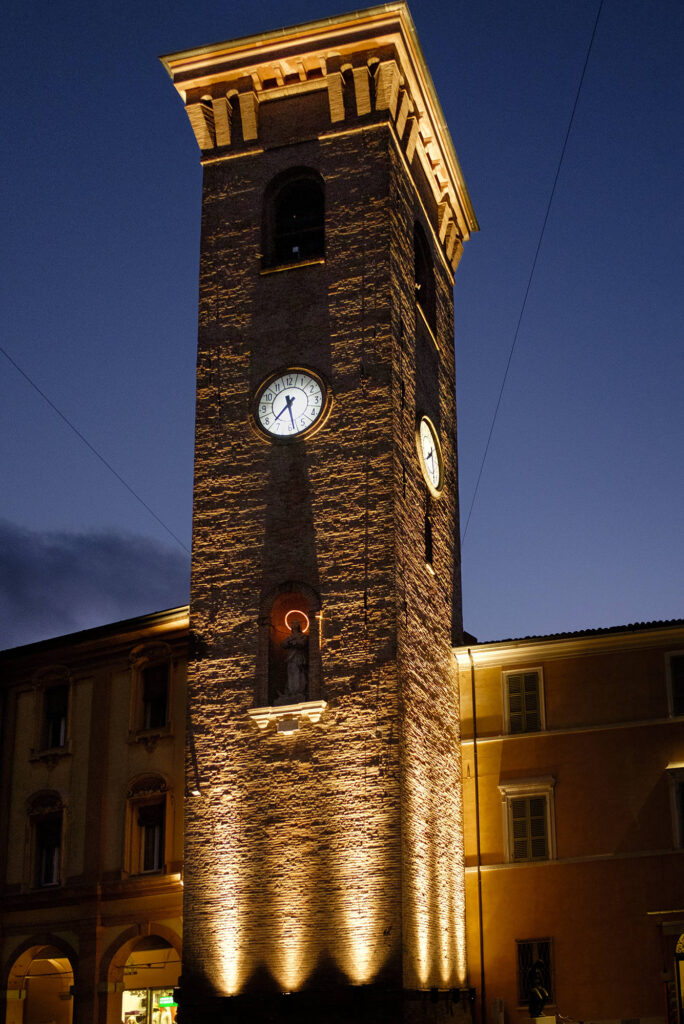
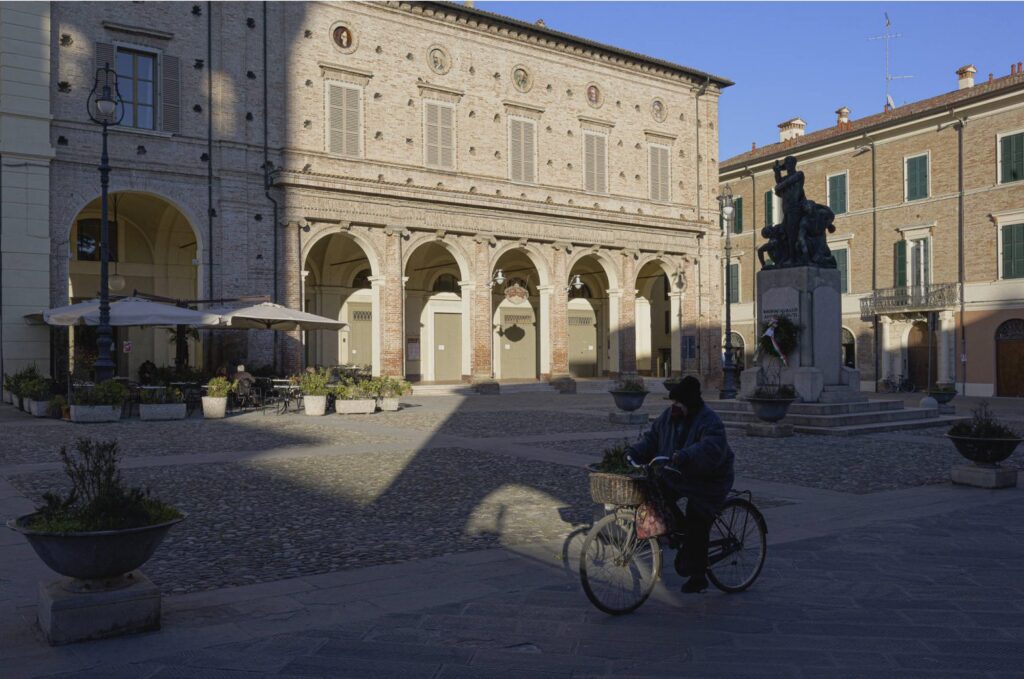
Bagnacavallo still retains its medieval layout intact today, with a radial structure centered on Piazza della Libertà. Modified at the end of the 18th century, the square contains the 18th-century Town Hall (Palazzo Comunale), built from a design by Cosimo Morelli, the Carlo Goldoni Municipal Theatre, inaugurated in 1845 with 19th-century frescoes, the ‘Palazzo Vecchio‘ (Old Palace), the ancient municipal seat, and the 35-meter-high Civic Tower (Torre Civica), erected in the mid-13th century.
For several centuries, the lower floor of the tower was used as a prison; here, in 1849, the brigand Stefano Pelloni, known as Il Passatore (a nickname derived from his father’s job as a ferryman on the Lamone river), was imprisoned.
Adjacent to the square is the Church of the Suffrage (Chiesa del Suffragio), a Baroque-style building with an exposed brick facade.
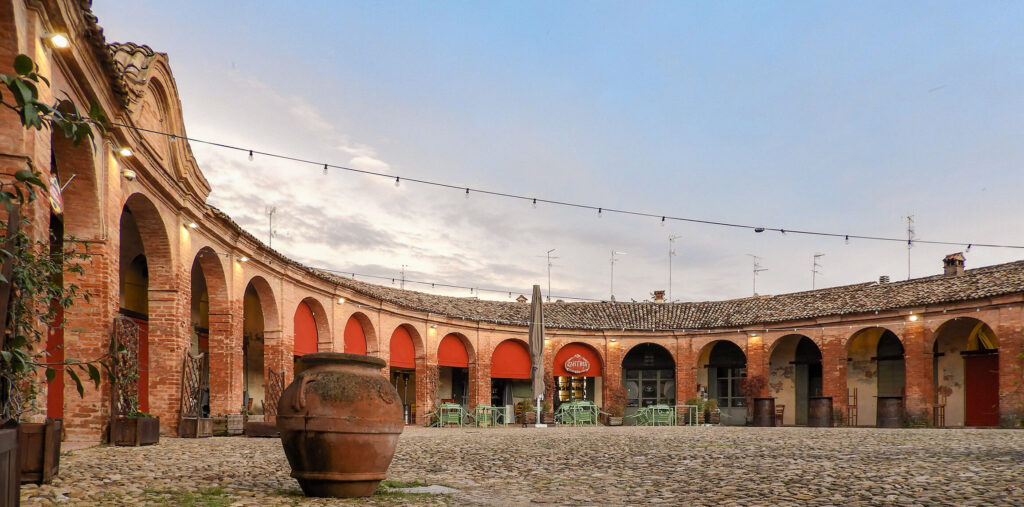
Hidden by adjacent buildings is another square built in the 18th century with a singular elliptical shape: Piazza Nuova (New Square). Characteristic and original, it features a portico with a succession of thirty round arches on square pillars, where the shops of butchers, fishmongers, and oil sellers once opened. Designed to meet the needs of rationality and hygiene, this square represents a particular example of a purpose-built commercial center.
Used today for events and cultural manifestations and as a summer cinema arena, it also hosts some artisan workshops, a fine tavern (osteria) offering local, seasonal cuisine rich in traditions, and a wine cellar featuring the best Romagna labels.
In the building that was, from the second half of the 18th century until 1971, the Convent of the cloistered Capuchin nuns, is the Multi-Purpose Cultural Center (Centro Culturale Polivalente). It houses a modern and historical library, an ethnographic section with numerous objects and tools of peasant work, a scientific-naturalistic section with various collections of minerals, reptiles, insects, and mollusks, an archaeological section with Roman-era artifacts found in the area, and an art gallery with ancient, modern, and contemporary works, including pieces by Bartolomeo Ramenghi. A painter born in Bagnacavallo in 1484, he later trained in Bologna where he died. His style, characterized by the somewhat mannered sweetness of Ferrarese painting and the simplicity of 15th-century Emilian-Romagnol painting, can also be admired in the Collegiate Church of St. Michael the Archangel (Collegiata di San Michele Arcangelo), where an altarpiece depicting the Redeemer and Saints is kept.
One kilometer from the center stands the Basilica of San Pietro in Sylvis, a fine example of Exarchal architecture (7th century), whose name attests that the building was constructed at the edge of a wood (silva). The facade, extremely simple with pilasters marking the internal tripartite division, is in exposed brick, lightened by an elegant mullioned window. With a rectangular plan divided into three naves, it is decorated with 14th-century frescoes from the Rimini school.
At the center of the raised presbytery stands out a pillar altar made of Greek marble from the end of the 6th century. A curious fragment is that of the so-called ‘Madonna with the Dante-esque Profile’ (Madonna dal profilo dantesco), almost a homage to the Supreme Poet who perhaps stopped to pray in this church on his journey to Ravenna.
Article published on piunotizie.it.
Share