March 1, 2023
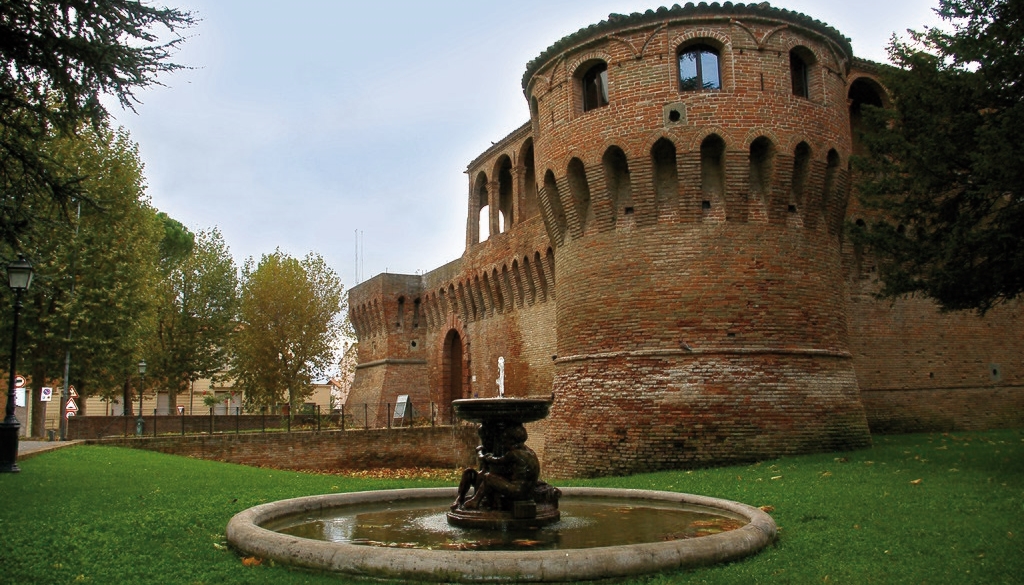
The presence of the Etruscans, followed by the Gallic Boii and Lingones, is certain in the territory of Bagnara di Romagna, an interesting center in the north-western sector of the alluvial plain surrounding Ravenna. The Roman centuriatio land division is still evident here today, with the Via Longa, the cardo maximus of Bagnara, perpendicular to the Via Emilia.
Destroyed in 1222 by the Bolognese Guelphs fighting against Imola, which at the time possessed the ‘castle’ of Bagnara, the town was rebuilt around the vanished Oratory of San Giovanni, upon which the Archpriest Church of SS. Giovanni e Andrea was erected in 1484. The church, transformed and enlarged first in the 17th century and subsequently in the 18th century by the Imolan architect Cosimo Morelli, preserves, in addition to the stone baptismal font and the 15th-century sandstone tabernacle portal, the statue of the Madonna del Voto, a polychrome terracotta from the same period, found in the embankment of the Santerno River. Following a council decree in 1631, for the preservation from the plague, the annual festival of the Pubblico Voto was established, celebrated in the month of July.
A fortified site as early as 1129, as attested by a papal bull, Bagnara is the only example of a medieval ‘castrum’ (fortified settlement) entirely preserved in the Emilia-Romagna plain. The fortification of the town was always of the utmost importance, due mainly to its strategic position relative to Imola, which provoked numerous struggles among various powerful families for its possession, leading to many modifications including the construction of the keep by Caterina Sforza. Of notable interest today are the keep and the central courtyard, restored to its Renaissance appearance, some internal rooms with original wooden ceilings, the iron supports of the drawbridge located to the south, the beautiful loggias on the eastern and northern curtains, the reserve water well, and the spiral staircase formed by 78 superimposed sandstone monoliths. Currently housing the mayor’s office and municipal offices, it is also worth a visit for the council chamber where eight paintings from the 17th and 18th centuries by the Bolognese school can be admired.

All this earned Bagnara di Romagna entry this year into the Club of Villages, created by the Association ‘I Borghi più belli d’Italia’ (The Most Beautiful Villages of Italy) with the aim of enhancing the great heritage of history, art, culture, environment, and traditions present in small Italian centers which are, for the most part, marginalized from visitor and tourist flows.
Also worthy of a visit is the Sanctuary of the Blessed Virgin of Succour (Santuario della Beata Vergine del Soccorso), built in the 18th century from a design by Cosimo Morelli, which houses a ceramic image of the Madonna del Soccorso, once placed on an oak tree above a pool whose waters were considered miraculous, to which the population entrusted itself for protection.
In 1975, the Pietro Mascagni Museum was established thanks to the donation by Anna Lolli, a native of Bagnara who was an inspiration to the maestro from Livorno. The centerpiece of the collection is an epistolary of Mascagni comprising about 5,000 letters, supplemented by various memorabilia including a piano, sheet music, and photographs.
Alongside this, the Parochial Museum A. Mongardi was created, collecting religious objects predominantly from churches in the Bagnara area, such as the altarpiece by Innocenzo da Imola, a rare antiphonal, a gradual, a Bible, and a 16th-century Concordantiae Biblorum.
Near the town is the Villa Morsiani-Bernardi, a building belonging to the ancient Romagnol family of the Counts Morsiani, fortified in the 15th century, modified in the 18th century, and adapted into a noble residence with a beautiful private chapel. Since the post-war period, it has housed a center known and appreciated internationally for the breeding and selection of the Saint Bernard dog, a great passion of the family, in addition to being the headquarters of the ‘Antonio Morsiani’ International Foundation for Dog Studies, established in 1996 and unique of its kind for the culture and scientific studies of cynology.

Bagnara di Romagna is also known for being the first center in Romagna to boast the cultivation of saffron, thanks to Cristiana Conti who, with her family, decided to change their way of life, purchased land with an old ruin, and in 2011 planted saffron bulbs bought from Sardinia, giving life to the ‘I Cuori’ Agritourism Farm.
Article published on piunotizie.it.
Share