February 27, 2023
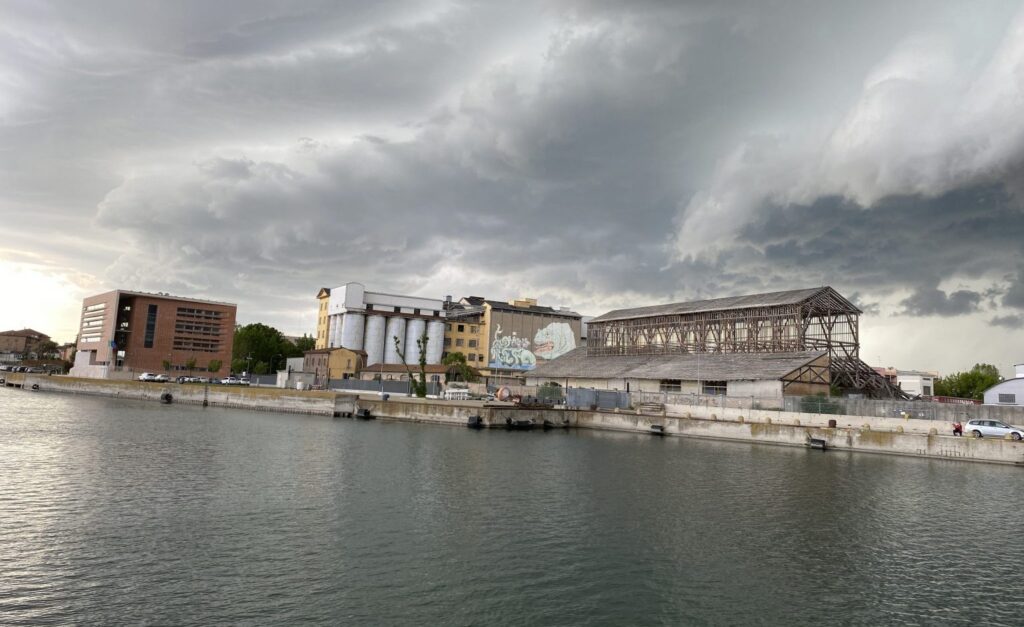
The neighborhood facing Ravenna’s port canal, long forgotten and not fully exploited in its potential, has been undergoing major transformations for a few years now and is increasingly establishing itself as a new city hub.
Like other international locations, such as New York and Barcelona for example, which have long known how to enhance their sea fronts, Ravenna has also undertaken a path of urban regeneration aimed at making this area more attractive, offering social spaces, services, and initiatives.
The Darsena of Ravenna is a place of many facets, a blend of sea, history, and innovation. The Corsini Canal, a new port canal symbolizing the city’s eternal link with water, was built in the 18th century and dedicated to Pope Clement XII Corsini, but the people of Ravenna have always called it Candiano, or rather “E Cangiân” in Romagnol dialect, attributing to it the name of a pre-existing canal located further south.
It was thanks to the construction of the railway link in 1862 that the area’s modernization phase began, which in 1888 officially assumed the name Sobborgo Darsena (Dock Suburb), initiating industrial take-off. But the bombings of the First and Second World Wars severely tested its development, which however arrived in the 1950s, a period of great expansion that led to the birth of Eni’s Anic complex and the growth of SAROM, followed, in subsequent decades, by the modernization of the port and the increase in maritime and commercial traffic.
Today, many buildings have been abandoned with the closure of businesses, but they represent our heritage of industrial architecture, from the Magazzino Fiorentina, with its three-nave structure entirely in wood, to the famous “sigarone,” the former SIR warehouse characterized by its series of ogival reinforced concrete arches. Some have already been converted, like the Artificerie Almagià – from a sulfur warehouse, part of an important industrial complex that also included a refinery, into a cultural hub managed by Rete Almagià, an association of associations that brings together some city entities operating in the fields of theater, dance, music, and visual arts. Or like Il Darsenale, inaugurated in 2019, a modern brew-pub created in a former industrial warehouse which, in addition to offering dining, serves craft beer produced directly on-site in the visible plant at the center of the venue.
The skyline along the Lungo Candiano is animated by the colors of the former Molino Pineta, transformed into a residential building by Milanese architect Cino Zucchi (the same architect behind the famous Lavazza headquarters in Turin), on one side, and on the other by the mural by Ericailcane, an Italian street artist established internationally, which reveals itself to passersby like a large cinema screen.
Venturing into the neighborhood, many murals come into view, created over the years thanks largely to the Subsidenze festival, organized by the Associazione Culturale Indastria, whose soul and mind is Marco Miccoli, and which led to the birth of the Cittadella della Street Art (Citadel of Street Art), thus giving a new face to the public housing buildings through the involvement of the residents themselves.
This evocative place, immortalized by Michelangelo Antonioni in the famous film “Red Desert” (Deserto Rosso), today teems with locals and visitors alike seeking the sea breeze and some leisure in a context of great contemporary appeal, walking on the new wooden footbridge along the dock accompanied by the words of writers, artists, and illustrious men dedicated to Ravenna.
The hub of recreational and sports activities is undoubtedly the Darsena Pop Up, the result of a social regeneration and activation intervention that translates into a place combining sociability, innovation, and sustainability, a center for sports and leisure activities: beach tennis, beach volleyball, parkour, calisthenics, skateboarding, but also a bar, ice cream parlor, pizzeria, and restaurant. An innovative “cargotecture” project involving the reuse of shipping containers in architecture, also creating a link with the activities of Ravenna’s port itself.
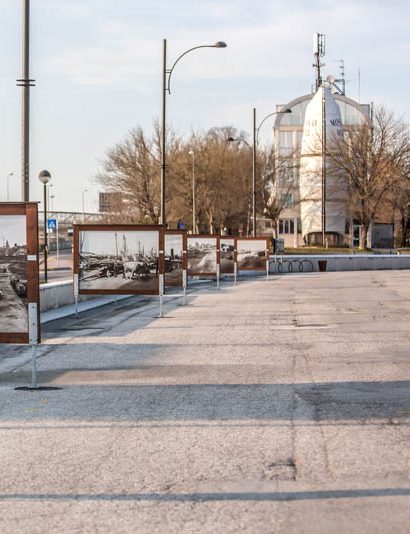
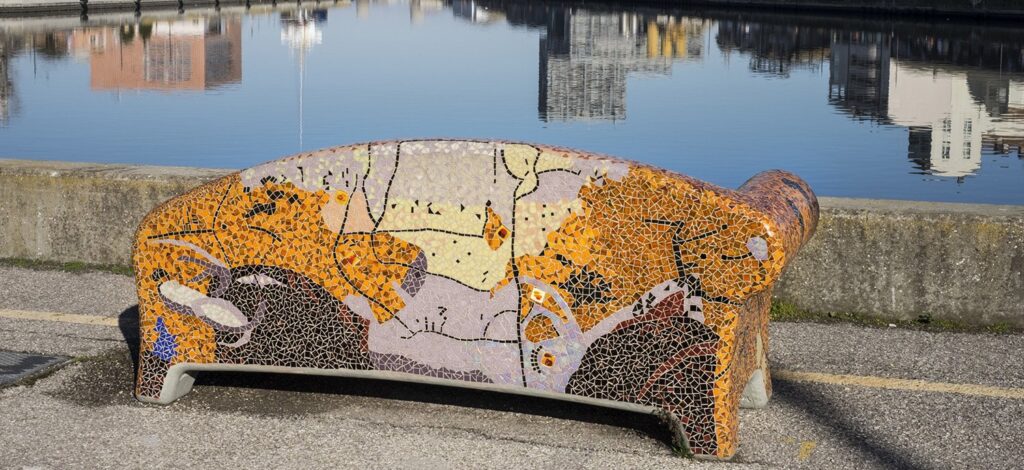
Speaking of sports, one certainly cannot forget the Moro di Venezia, the boat that stands out in all its imposing stature at the head of the Darsena, a symbol of Ravenna’s nautical pride. Walking here, you can relive history through the photographic panels lining the dock and reach the mosaic monument dedicated to former mayor Fabrizio Matteucci, or stop to admire the horizon sitting on one of the mosaic benches – permanent urban furniture works created with the collaboration of the Art Institute on the occasion of the Biennale of Mosaic in 2015.
In the background, the characteristic sail-shaped structure of the Hotel Mosaico also stands out, the main accommodation facility, managed by Ravenna entrepreneur Maurizio Bucci, ideal for tourists who want a view of the Darsena and the city from a new perspective.
For those who wish to delve deeper and learn more about the history, development, and events concerning Ravenna’s Darsena, we invite you to browse the website resulting from the DARE project, where urban regeneration becomes digital, by exploring the various specially created story maps.
Article published on piunotizie.it.
Share