March 1, 2023
Nestled on the left bank of the Senio River, a strategic position that proved fatal during the Second World War, Cotignola is largely the result of post-war reconstruction. Its name, first found in a document from 919 AD, likely stems from the land’s particular suitability for cultivating quinces (cotogna).
Under the rule of Faentines, Bolognese, Estensi, the Counts of Cunio, and the Sforzas, Cotignola experienced fluctuating fortunes from the 13th century onwards. It was thanks to the condottiero John Hawkwood (Giovanni Acuto), who received the Castle of Cotignola in 1372 from Pope Gregory XI, whom he had served for years, that Cotignola, encircled by new walls and ramparts, became of significant importance.
It was this very mercenary captain who built the Torre d’Acuto in 1376, reconstructed in 1972 after being blown up by the Germans in 1944, now the symbol of Cotignola. At its top stands “E’ Campanòn”, the civic bell from 1616, featuring bas-reliefs of sacred images and the coats of arms of some ancient Cotignola families, including the Rossinis, ancestors of the great musician Gioacchino Rossini.
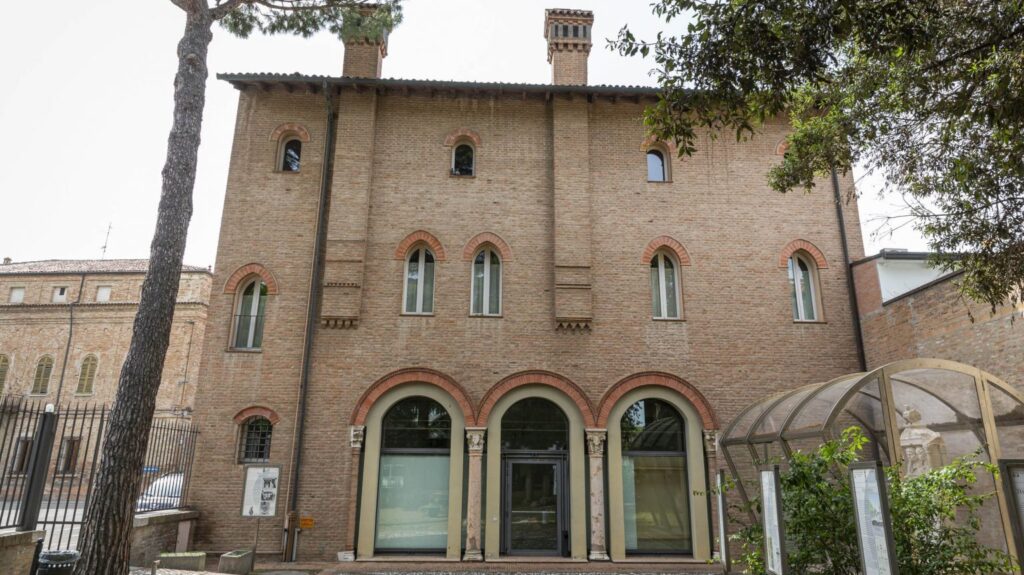
Palazzo Sforza was also destroyed during the war and rebuilt in 1961, based on a design by architect Carlo Visani, respecting the original forms of which it still retains the brick rose window with the family coat of arms and some architectural elements. It currently houses the Civic Museum “Varoli,” hosting temporary exhibitions on the ground floor, and an archaeological room and a section of the most significant works by Luigi Varoli on the first floor. Varoli was a Cotignola painter who lived in the building opposite the palace, known as the Sforza stables, and directed the School of “Arts and Crafts” for several years. The museum collects valuable testimonies of Cotignola’s folklore, such as the papier-mâché masks created by the master for the Sagra della Segavecchia – a traditional event held since 1451 in the middle of Lent – and numerous archaeological finds attesting to Roman settlements existing even before the Christian era. These include a Roman stele, datable to 30-40 AD based on epigraphic and stylistic features, found in 1817 during the construction of the bridge on Via Gabina. The stele, a rare example of “learned” art in a provincial setting, was part of a funerary monument dedicated to a family of wealthy freedmen liberated by Caius Varius.
In 2013, following a short residency by Spanish artist Gonzalo Borondo, a project began connecting the museum to the landscape through a branched path of painted walls (the map curated by Romagna Sentieri can be consulted at this link). This ideal itinerary includes the three natural areas – Parco Pertini, Lago dei Gelsi, and Isola dell’Albaraz – reaching into the countryside. Here, in a setting characterized by a wide floodplain of the Senio River and a grove of acacia trees, the cultural association Primola organizes the “Arena delle Balle” every July – the only straw amphitheater in Romagna – featuring concerts, theater performances, poetic meetings, and imaginative, rustic land art.
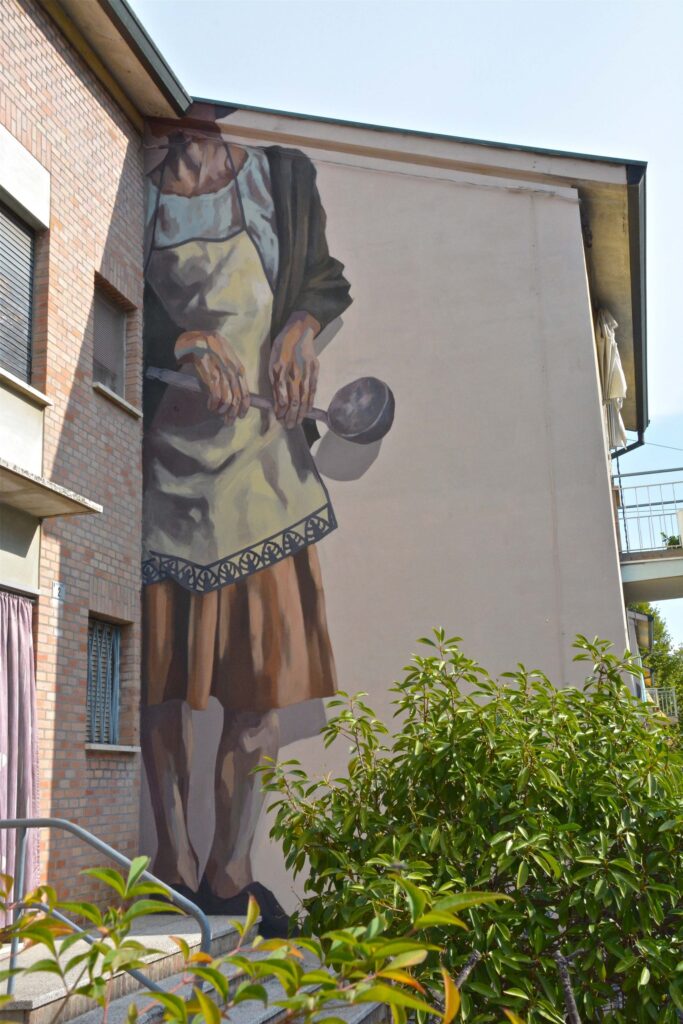
Many street artists have contributed to enriching this initiative over the years, including About Ponny, Reve Più, Gola Hundun, Dem, and Tamara Djurovic, aka Hyuro. This Argentine artist, who passed away prematurely, created the mural “L’Árzdora,” evoking the structure of the patriarchal family – extremely hierarchical and codified with strictly accepted rules – through a double headless woman with a ladle in hand (one whole, the other broken), symbolizing the domestic duties assigned by the mother-in-law to the daughter-in-law upon her entry into the new family.
Among the various works, the “Distributore non automatico di Coraggio” (Non-Automatic Courage Dispenser) certainly deserves mention. This mural, created in 2015 by the FX Collective on an Enel cabin, depicts a series of paintings and windows featuring the protagonists of those long 145 days when the front line stalled on the banks of the Senio River, from November 1944 until the liberation of the town on April 10, 1945. Among them are the faces of the four Cotignola “Righteous Among the Nations”: the aforementioned Luigi Varoli and his wife Anna, and Vittorio and Serafina Zanzi, who worked to create a reception network that managed to save 41 Jews persecuted by the racial laws.
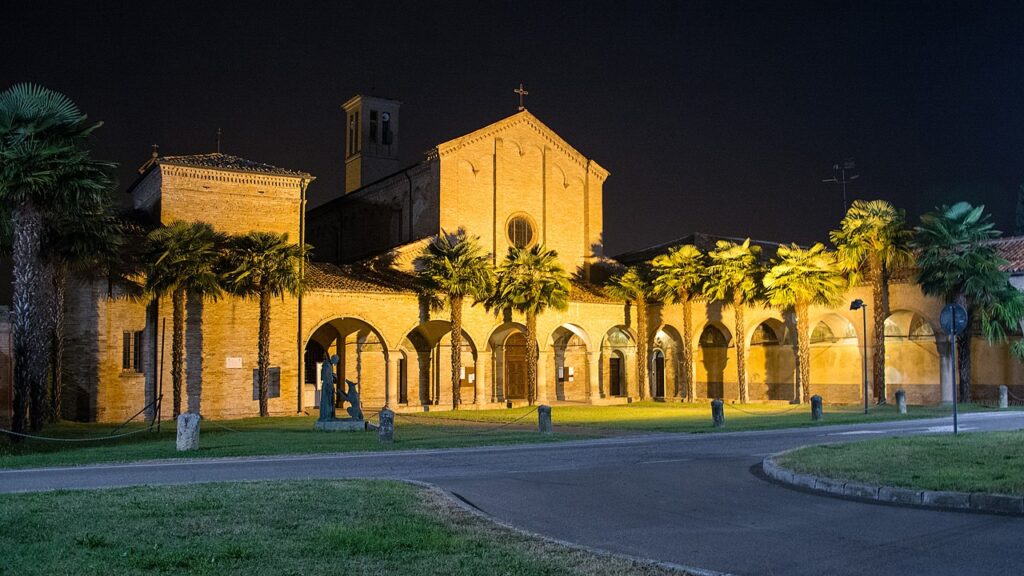
Also worth visiting is the Church of San Francesco from the late 15th century, which houses the body of the Blessed Antonio Bonfadini, patron saint of Cotignola, whose feast day is on Easter Monday. Unfortunately, many works were removed during the Napoleonic era, but it is still possible to admire some frescoes, such as the lunette of the Pietà (15th century), part of an altarpiece by Francesco Zaganelli, and the Pietà attributed to Gerolamo Marchesi, placed above the main altar, whose sinopia remains above the entrance door of the left nave. Next to the church, connected by a graceful loggia, is the Chapel of Santa Maria degli Angeli, transformed into the Sforza burial chapel. The apse and vault are decorated with remarkable frescoes by the Zaganelli brothers; restoration work has also uncovered a fresco depicting St. Francis receiving the Stigmata, attributable to Gerolamo Marchesi.
Article published on piunotizie.it.
Share