February 15, 2023

Located on the left bank of the Lamone River, halfway between Imola and Forlì, along Emilia-Romagna’s main communication route – the Via Emilia – Faenza is known throughout the world for its ceramics, so much so that “Faïence” has become synonymous with majolica.
Ceramics, undoubtedly one of the oldest arts, became established in Faenza, also thanks to the clay-rich soil, particularly in the Middle Ages, when the city became a center of primary importance. From this early phase, raw clay artifacts were subjected by artisans to the two coating processes that would later allow for decoration: ingobbiatura (slipware), a light layer of white clay made waterproof by a veil of glaze and decorated by incising with a nail, and subsequently, glazing, with the typical brush decoration (majolica).
In the Renaissance period, there were 30 factories in Faenza that decreed its fame.In 1963, after a period of crisis following the spread of Oriental porcelain, the Ferniani family took over the only large surviving factory, decreeing the rebirth of this art in Faenza. The presence of the Ferniani manufactory was decisive both for the evolution of taste and for the experimentation of new techniques, such as that of the “piccolo fuoco” (low-fire), which allowed the use of chromatic tones that a high temperature would not have fixed.
The closure of the Ferniani manufactory in 1893 caused a new crisis in the ceramic art, although other factories were active alongside some prestigious artists.
In 1908, the International Museum of Ceramics (Museo Internazionale delle Ceramiche), the work of Gaetano Ballardini, was inaugurated. Important collateral initiatives followed, such as the foundation of the specialized magazine Faenza, the birth of the G. Ballardini Art Institute for Ceramics (Istituto d’Arte per la Ceramica G. Ballardini), the International Competition of Artistic Ceramics (Concorso Internazionale della Ceramica d’Arte), and the Ceramics and Antique Ceramics Market Exhibitions (Mostre Mercato della Ceramica di Faenza e della Ceramica di Antiquariato).
Located in the building reconstructed on the premises of the former Convent of the Camaldolese Nuns of S. Maglorio, the museum has become an important cultural center for research and documentation of ceramics from all over the world and offers the public a wide selection of what has been produced from classical antiquity to the present day.
This art, handed down through time, still lives today thanks to the numerous active workshops, concentrated mainly in the historic center, which offer tourists the possibility of a unique purchase, the fruit of the skilled hands of Faenza artists.
Linked to the ceramic tradition, the Mondial Tornianti (World Potter’s Wheel Championship) was born, a unique event that sees the best ceramists from all over the world compete. The master potter who creates, with the same quantity of clay, the tallest cylinder and the widest bowl, each within 20 minutes, is awarded the title of world champion.
Faenza is part of the European Route of Ceramics (Strada Europea della Ceramica), a cultural route certified by the Council of Europe that aims to enhance the cultural heritage linked to ceramic production and its ancient tradition, creating a sustainable and competitive tourist offer based on artistic productions and collections and on overall cultural and social development.

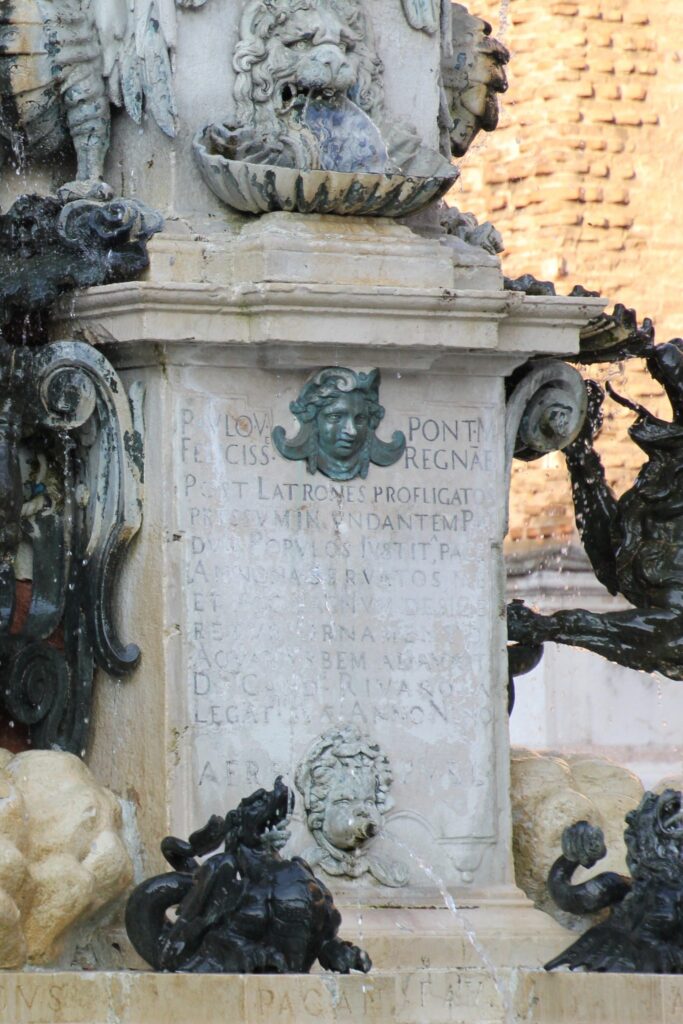
A visit to the “city of ceramics” is not complete without having taken in, at a single glance, the ensemble of Piazza del Popolo, with its characteristic porticoes, and Piazza della Libertà, which contain the city’s main monuments: the Cathedral, an imposing Renaissance building designed by the Florentine Giuliano da Maiano; the monumental Baroque-style fountain, the work of Domenico Paganelli, who was also the author of the nearby Clock Tower (Torre dell’Orologio), destroyed during the Second World War and faithfully reconstructed; the medieval Palazzo del Podestà, the ancient residence of the Municipal Magistracy, and the Municipal Palace (Palazzo Municipale), formerly the palace of the Manfredi family, from which one accesses the Corte della Molinella onto which the Masini Theatre (Teatro Masini), from the end of the 18th century, designed and built by architect Pistocchi, faces.
Article published on piunotizie.it.
Share