March 1, 2023
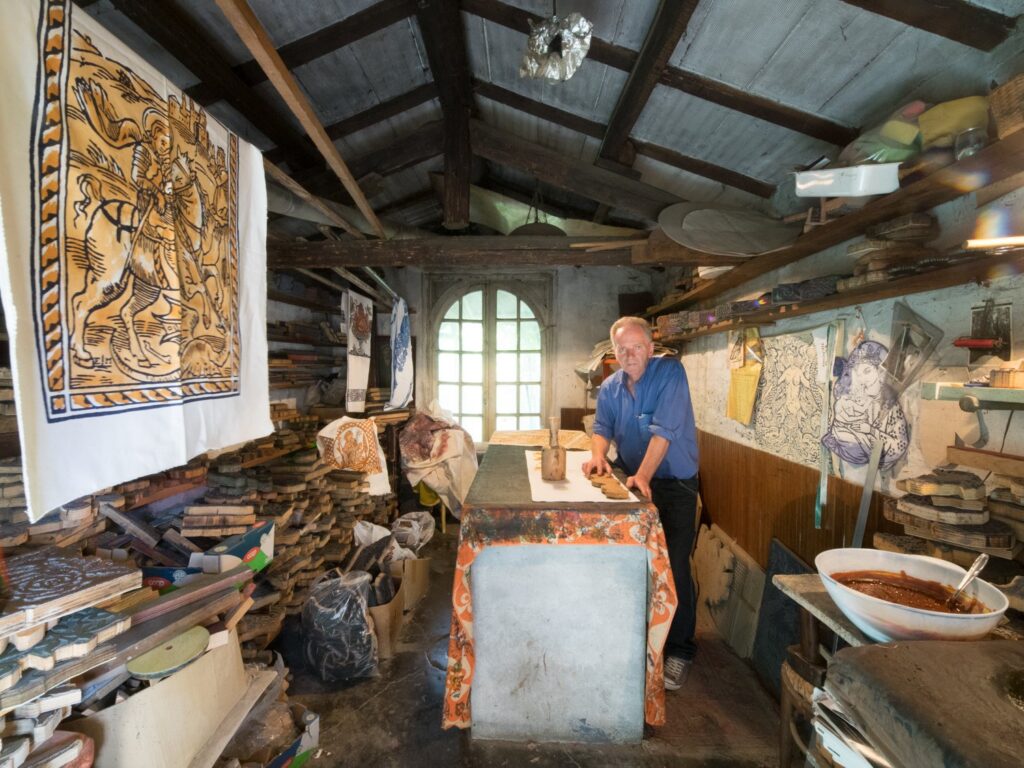
The hand-printing of fabrics boasts a long tradition in Romagna, originally linked to humble craftsmanship and peasant creativity, using pear wood stamps (easily available), color obtained from rust, and hemp which was cultivated in the fields and woven at home on looms.
Historically, the oldest documents found place it in the first decades of the 19th century, but this art was widespread in the Papal State, of which Romagna was a part until the Unification of Italy, as early as the 17th century.
However, it is limiting to relegate printed fabrics solely to the peasant world, considering that not all decorations are inspired by the rural world. Favorites from that world include roosters, vine tendrils, grape clusters, mugs, pine cones, ears of wheat, caveje (the typical connecting pin between the oxen yoke and the cart), and the image of Saint Anthony, the patron saint of animals and the agricultural world, which was printed on the cloths peasants used to cover their animals. In fact, a strong intention to reproduce, using more economical methods, the decorations and embroidery of the fine fabrics of the wealthier classes is noticeable.
The traditional color of printed fabrics is the “rust paste,” whose specific components and proportions each printer jealously guards. It derives from mild steel oxidized with wine vinegar, to which iron sulfate bonded with wheat flour is added.
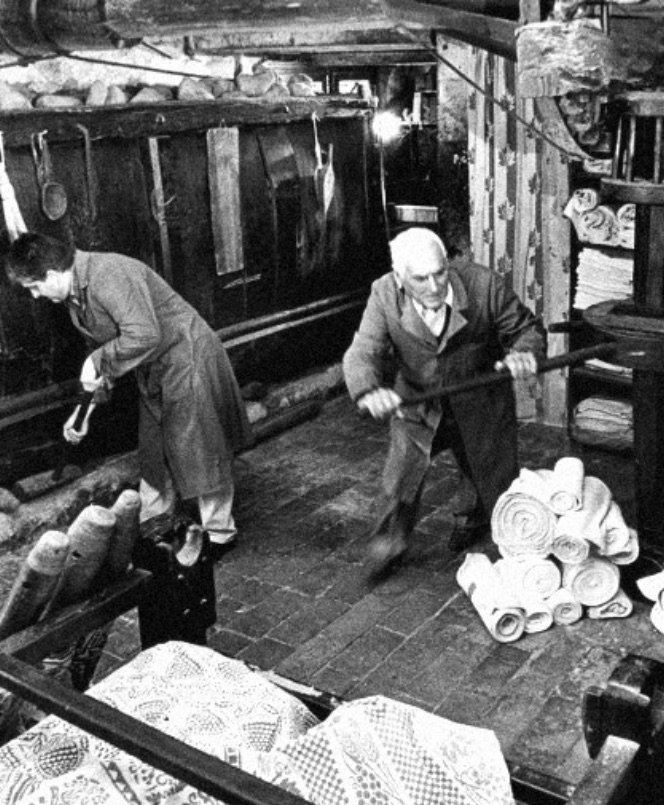
The printing process is well illustrated by Fabio Visini, honorary president of the Associazione Stampatori Tele Romagnole (Romagna Fabric Printers Association), which preserves and protects this ancient art: «After preparing the raw cloth on the workbench, the stamp is placed on the pad where the color has been spread, then with a steady hand it is applied to the fabric—hemp, linen, or cotton—pressing it with the arm and tapping it with the wooden mallet so that the design imprints on the cloth. By hammering more or less vigorously as needed, with regularity or variation in rhythm, one gives the work that personal tone that distinguishes the preciousness of the artisan’s labor.»
Great skill is also required in carving the stamps, originally predominantly made from pear wood, which is soft to carve but simultaneously resistant to the blows of the mallet.
Today, the printers carrying on this tradition have a personal decorative heritage, also the result of their own interpretation, creativity, and desire for innovation, thus offering an extraordinary variety of decorations, colors, fabrics, and applications: from table linens and kitchen accessories, to bathroom linens, cushions, curtains, and even clothing.
Two such printers operate in the Ravenna area, who with passion and dedication put their art at the service of handmade enthusiasts.
Working in his small and creatively chaotic workshop in San Zaccaria is Egidio Miserocchi, a true artist, an experimenter. He set aside his degree in architecture when, wandering among the farmhouses of Romagna in search of material for his thesis, he discovered this art which fascinated him immediately and led him to research its origins, later adding his own experience and vision. His technique is unique, in continuous flux. He offers traditional subjects and new images, uses printing blocks but also the paintbrush, sometimes coloring what is not part of the design. Many of his dyeing techniques were revealed to him by elderly Romagna residents and stem from stubborn attempts to achieve the desired result: truly original vibrant and intense decorations.
C’era una volta (Once Upon a Time) is an elegant print shop and boutique in the heart of Cervia’s historic center. The owner, Elisa Drudi, runs the business together with her husband, with great cordiality towards customers and tourists who, curious, ask to see a demonstration of the printing technique. Indeed, at the back of the premises, past counters and shelves set up for sales, the space is dedicated to wooden printing blocks, colors, and especially the beautiful printed fabrics hanging to dry on bamboo canes.
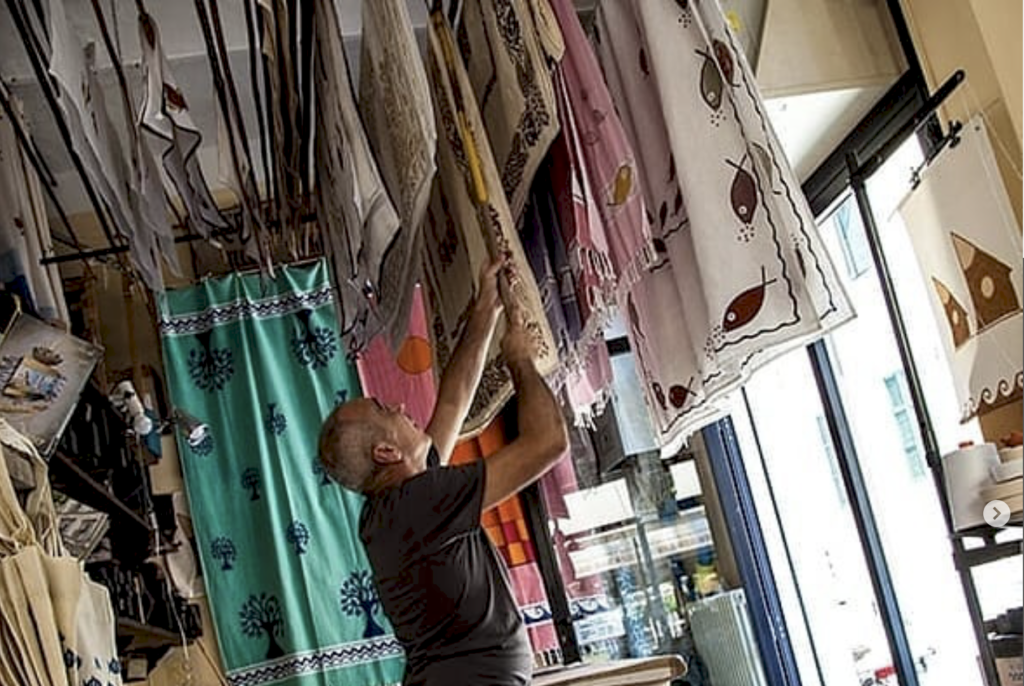
In our area, we can also find two shops where one can get lost among home linens, colors, and patterns. In central Ravenna, La Stamperia dei Pascucci has been located for years, a small shop offering products from the historic Gambettola family of dyers who, since 1826, continue to pass down this precious art. However, those who conceived La Bottega degli Asini in Brisighella in 2016 are Ravennate by adoption. Sergio Frantini, who for years owned the J&J advertising studio in Ravenna, together with Anna Pia Casale, a restorer who graduated from Ravenna’s restoration school, gave life to a shop that speaks of traditions, local culture, craftsmanship, art, innovation, handmade products, and Romagna excellence.
In markets and local (and non-local) shops, one can find industrial reproductions of this type of print, but a discerning eye immediately recognizes the difference. Just look at the reverse side, because in hand printing, you can see the design and the print color, as well as imperfections. Furthermore, observing a manually printed design reveals shading, an uneven distribution of color, and sometimes slight misalignments due to the composition by juxtaposition of the stamps. And it is precisely this that makes the fabric exclusive. So beware of imitations!
Article published on piunotizie.it.
Share