February 27, 2023
Street art or urban art defines a set of art forms that manifest in public spaces, often illegally as a sign of protest or condemnation of the system, using a variety of techniques: spray cans, stickers, stencils, screen printing, video projections, sculptures using reclaimed materials.
Having risen to prominence from the 1960s-70s in America, within mass society, with writing or graffiti art, it has developed explosively in the last two decades, even crossing borders, although there is still skepticism and differing positions on the artistic value of these works.
In Italy, it took its first steps in 1982 thanks to the work of Francesca Alinovi, a researcher in the Visual Arts department of the University of Bologna. Bologna, incidentally, was one of the first European cities to host a museum retrospective of writing.
Today, Ravenna holds its own compared to other international realities thanks to Marco Miccoli, a proponent of this art form, who has contributed enormously to its spread in the city.Walking through the historic center, it’s easy to come across many works by numerous Italian and international artists. Like those of Invader, a French artist who first came to the city in 2014, invited by the Associazione Pianeta Marte, to create a work for the Planetarium where the “mythical” Spock from Star Trek can still be admired today. Invader uses small colored tiles that recreate computer image pixels, forming a trait-d’union with the mosaic technique for which Ravenna is known worldwide. The artist left us 40 works in two waves, as he calls them, although some are no longer visible today because they were removed or damaged.
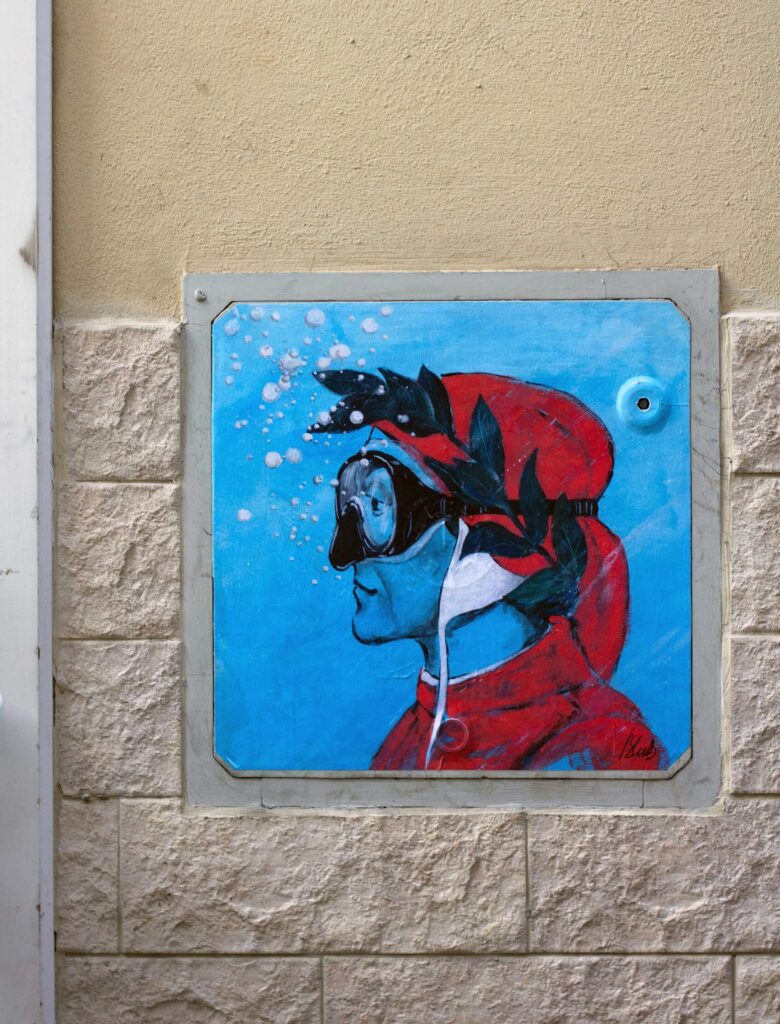
The same fate for Blub, a Florentine artist who delights cities with paintings and portraits of famous characters wearing diving masks, created using the poster art technique and glued onto gas or electricity meter cabinet doors. Unfortunately, time and some “rogues” have taken away some of these works, but you can still encounter Andy Warhol, the Mona Lisa, Marilyn Monroe, David, Salvador Dalì, and Dante Alighieri on the streets of Ravenna.
The Supreme Poet was also the subject of many illustrators and artists on the occasion of the Dante Plus exhibition, and next to his tomb, you can still admire the interpretation by NoCurves, one of the major representatives of tape art internationally, and the face decomposed into pixels by Sicilian artist Salvo Ligama. But the most photographed of all is the Harlequin Dante by Kobra, a Brazilian artist who uses strong color contrasts and intersecting geometric shapes.
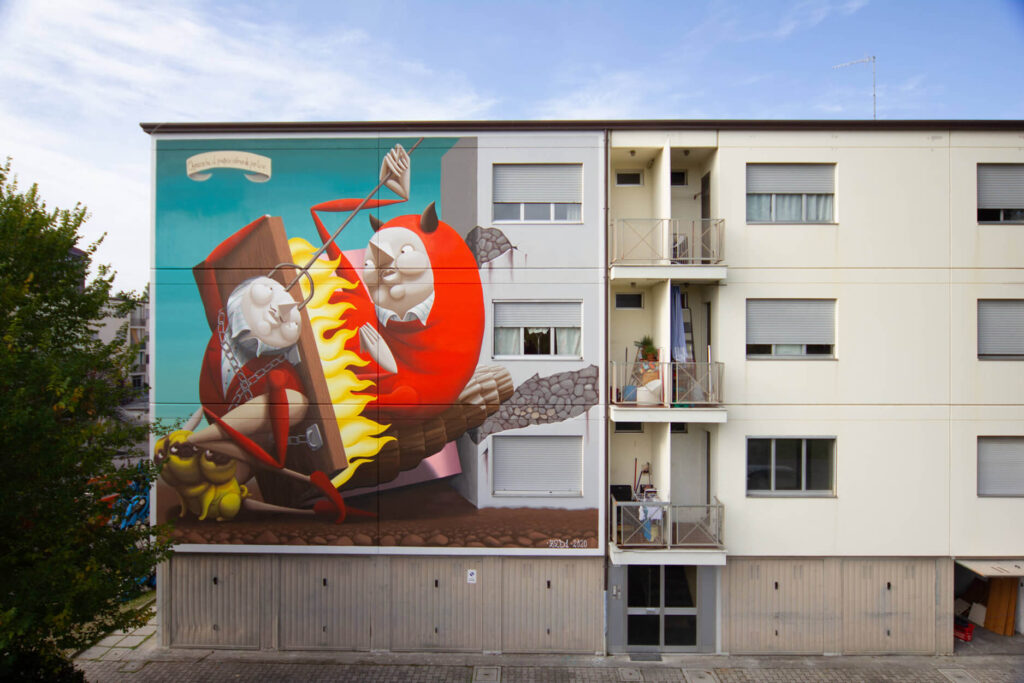
A discerning eye can spot truly precious gems like the delicate “little men” by Exit Enter who fly with balloons, cling to hearts, offer flowers, or the hearts to be protected with bulletproof vests by Zed1, the artist who tells fairy tales on walls and whom we can find in “technicolor” at the Cittadella della Street Art (Citadel of Street Art).
Born from the Subsidenze street art festival, it defines an area of public housing buildings, at the end of Via Tommaso Gulli, with symmetrical and square shapes that offered the ideal space for large murals created by artists of the caliber of Ericailcane, Basik, and Bastardilla, the most recent of which were painted by Biancoshock, Luogo Comune, and Millo on the occasion of the VI edition of the festival dedicated to Virgilio e Dante 4.0, nuove storie antichi maestri (Virgil and Dante 4.0, new stories ancient masters), held in September 2020.
Along the streets of the entire neighborhood, reaching the Darsena, numerous murals fill the eyes with color, including the enigmatic and symbolic figures of Camilla Falsini, the robotic individuals of PixelPancho, and the animals with geometric and abstract lines by the Belgian artist Dzia. This is thanks to the many artists, but also to the residents of the area who agreed to offer their walls, the Municipality of Ravenna, and all those who love this art form.
A fascinating contemporary itinerary, perfect to explore by bicycle, alone or accompanied by a city tour guide to better appreciate its history, message, and art.
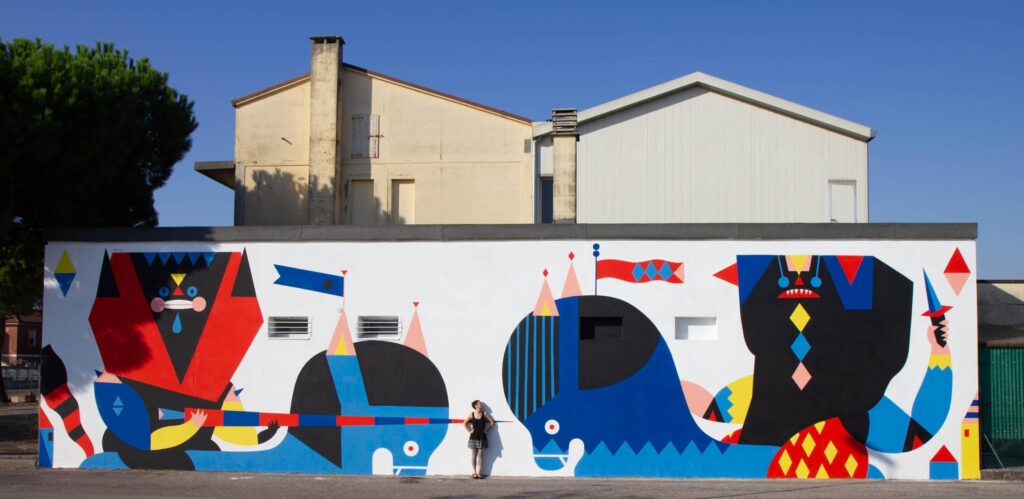
But the journey would not be complete without mentioning Tamara Djurovic, aka Hyuro, an Argentine artist who passed away prematurely and who, with grace and strength, knew how to speak about the difficult conditions of women and gifted us Mariposas (Butterflies), one of her last works, located at the Giardino Sorelle Mirabal near the stadium.
Article published on piunotizie.it.
Share